
Why Your Snare Drum Always Sounds Bad (And How to Fix It)
Jun 29, 2026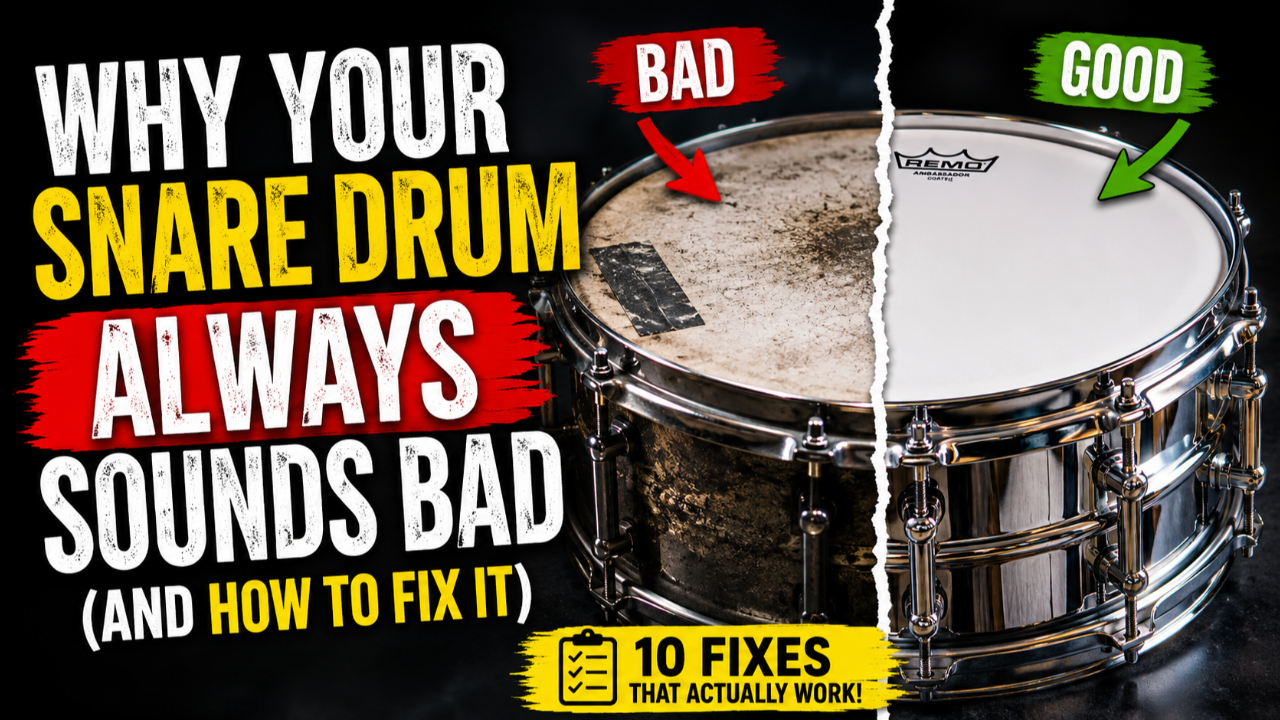
Why Your Snare Drum Always Sounds Bad (And How to Fix It)
If you've ever sat behind your drum kit thinking, "Why doesn't my snare sound anything like the ones on YouTube?"—you're definitely not alone.
This is one of the most common frustrations for beginner and intermediate drummers. You spend hundreds (or even thousands) of dollars on a drum kit, buy the same brand your favourite drummer uses, and somehow your snare still sounds like a cardboard box.
The good news? It's almost never the drum itself.
In fact, even an inexpensive snare drum can sound surprisingly good when it's tuned and maintained properly. On the other hand, a $2,000 professional snare can sound terrible if it's neglected.
Let's look at the biggest reasons your snare drum sounds bad—and, more importantly, how to fix each one.
1. Your Drum Heads Are Worn Out
This is easily the number one problem.
Drum heads don't last forever. Every stick hit stretches the plastic slightly, and over time the head loses its ability to resonate properly.
Signs it's time for a new head include:
- Deep stick dents
- Coating worn completely off
- Wrinkles around the edges
- Difficult or impossible to tune
- Dull, lifeless sound
Many beginners keep the same head on for years simply because it hasn't broken.
A fresh head can completely transform your snare drum.
Popular choices include:
- Remo Ambassador Coated
- Evans G1 Coated
- Evans HD Dry
- Remo Controlled Sound
Even changing just the batter head can make a huge difference.
2. Your Drum Isn't Tuned Properly
Most snare drums aren't "bad."
They're just badly tuned.
One loose lug is enough to ruin the entire sound.
Here's a simple tuning method:
- Loosen every tension rod.
- Finger-tighten each lug.
- Tighten using a star pattern.
- Tap beside each lug.
- Match every lug to the same pitch.
- Adjust overall tension until the drum feels right.
Take your time.
Small adjustments make a huge difference.
Remember, tuning is about even tension—not simply making the drum tighter.
3. Your Snare Wires Are Too Tight
Many drummers crank the snare wires as tight as possible.
Unfortunately, this usually makes the drum sound choked.
Instead of hearing a crisp snare response, you get a short, lifeless "thud."
Try backing the tension off gradually until:
- Ghost notes respond easily
- Rimshots crack nicely
- Buzz rolls sound smooth
- The drum breathes naturally
There should be enough tension for a clean response without strangling the drum.
4. Your Resonant Head Is Being Ignored
Everyone pays attention to the top head.
Very few people ever touch the bottom head.
Yet the resonant (snare-side) head has a huge influence on:
- Snare sensitivity
- Sustain
- Crispness
- Overall character
Generally speaking, the bottom head is tuned much higher than the top head.
If it's too loose:
- The drum sounds floppy.
- Snare wires respond poorly.
- Buzz becomes inconsistent.
Don't neglect this head—it matters just as much as the batter.
5. You're Hitting the Drum Poorly
Your hands affect your sound just as much as your equipment.
If you're:
- Choking the stick
- Tensing your wrists
- Hitting inconsistently
- Playing different parts of the head
…the snare will never sound consistent.
Aim to strike:
- Near the centre for full strokes
- With relaxed hands
- Using natural rebound
- At a consistent height
Good technique produces a better tone automatically.
6. You're Expecting Studio Sound in a Bedroom
This surprises many drummers.
The snare sound you hear on your favourite recordings isn't just the drum.
It's also:
- High-end microphones
- Compression
- EQ
- Reverb
- Room acoustics
- Mixing
- Mastering
A snare played in a small bedroom will never sound exactly like one recorded in a million-dollar studio.
That doesn't mean your drum sounds bad.
It simply means you're comparing two completely different situations.
7. Your Drum Is Sitting on an Uneven Surface
This one gets overlooked.
If your snare basket squeezes the shell too tightly, the drum can't resonate properly.
The basket should hold the drum securely—but not crush it.
Likewise:
- Don't overtighten mounting hardware.
- Make sure the basket arms support the shell evenly.
- Check that the drum sits level.
Small mechanical issues can noticeably affect resonance.
8. Your Room Is Working Against You
A drum kit always sounds different depending on where it's played.
Small bedrooms often exaggerate:
- Harsh high frequencies
- Ringing
- Boxiness
- Unwanted echoes
Concrete floors and bare walls make this even worse.
Simple improvements include:
- Rugs
- Curtains
- Bookshelves
- Furniture
- Acoustic panels
Even moving your kit to another part of the room can make a surprising difference.
9. You're Overusing Dampening
Many drummers immediately cover their snare with:
- Gel pads
- Tape
- Wallets
- Towels
- Heavy muffling rings
While dampening has its place, too much kills the drum.
Before adding muffling:
- Tune the drum properly.
- Replace old heads.
- Adjust the snare wires.
Often you'll find the drum no longer needs much dampening at all.
Start with the minimum amount necessary.
10. You're Chasing Someone Else's Sound
Every drummer has a different idea of the "perfect" snare.
Some love:
- Fat and deep
- Bright and cutting
- Dry and controlled
- Open and ringing
- Vintage warmth
- Modern crack
There isn't one correct snare sound.
Instead, think about the music you're playing.
A jazz snare should sound very different from a heavy rock snare.
Likewise, a funk drummer may prefer something completely different again.
Your goal isn't to copy someone else's drum.
It's to find a sound that works for your music.
A Simple Snare Drum Checklist
If your snare sounds bad, work through this list:
✅ Replace worn drum heads.
✅ Tune every lug evenly.
✅ Tighten the bottom head properly.
✅ Adjust snare wire tension.
✅ Check your playing technique.
✅ Reduce unnecessary muffling.
✅ Make sure the snare basket isn't choking the drum.
✅ Accept that your practice room won't sound like a recording studio.
You'll be amazed how much difference these simple changes can make.
Final Thoughts
The biggest mistake drummers make is assuming they need a better snare drum.
In reality, most sound problems come down to tuning, maintenance, setup, and technique—not expensive gear.
Learning how to tune your own snare is one of the highest-value skills you can develop as a drummer. It's something you'll use every time you sit behind a kit, whether you're practising at home, rehearsing with a band, recording in a studio, or performing live.
Spend a little time experimenting with head tension, snare wire adjustment, and your playing technique. Make one change at a time and really listen to the difference. Over time, you'll develop an ear for what works.
A great-sounding snare isn't about luck or owning the most expensive equipment. It's about understanding how the instrument works and knowing how to bring out its best.
Once you master those fundamentals, you'll discover that almost any well-maintained snare drum can sound fantastic.
